
What is a host adapter?
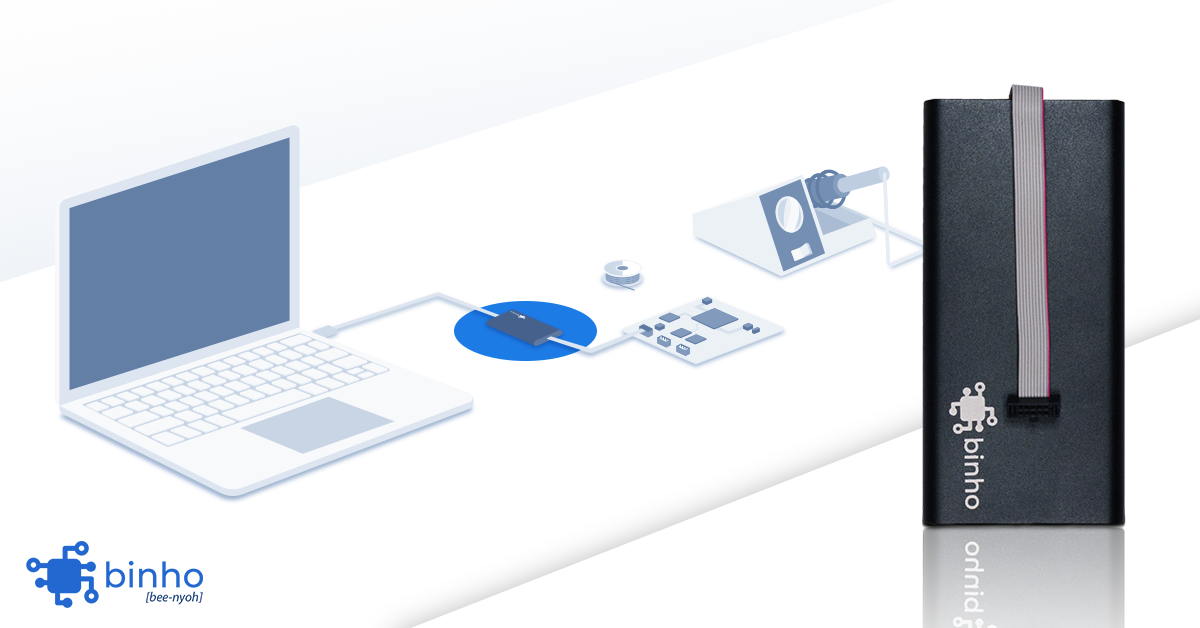
A host adapter connects a computer to chips that it cannot talk to directly. Sensors, memories, power ICs and microcontrollers use buses such as I2C, I3C, SPI and UART. A PC exposes none of these. A Binho USB host adapter plugs into USB and drives those buses under the control of software on the PC: Mission Control 3 with no code, or a script with PyCosmicSDK.
Which Binho Adapter Covers Which Bus
Section titled “Which Binho Adapter Covers Which Bus”| Adapter | Buses |
|---|---|
| Binho Supernova | I3C, I2C, SPI, UART, GPIO |
| Binho Pulsar | I2C, SPI, UART, GPIO, RS-485, CAN-FD |
| Binho Nova (legacy) | I2C, SPI, UART, 1-Wire, Single-Wire Interface (SWI), GPIO |
Details per protocol: Protocols and Interfaces.
What People Use One For
Section titled “What People Use One For”Bring-up and driver development. Talk to a new chip from a PC before the board or firmware exists. Write and debug the driver in Python, then port it.
Automated tests. Run the same script against every board revision or firmware build, for example from a CI job. Scripts replace manual checks that take hours.
Production programming and provisioning. Erase, program and verify EEPROM, Flash or FRAM; write serial numbers, MAC addresses or calibration data; load keys into a secure element. Several adapters on one PC can run in parallel. See Can multiple devices be used at the same time?
Programming a microcontroller through its ROM bootloader. Many MCUs accept new firmware over I2C, SPI or I3C with no debugger. Worked examples on binho.io:
- Flashing STM32 firmware over I3C using Binho Supernova
- Programming STM32 firmware over I2C using Binho Pulsar
- Programming STM32 firmware over SPI using Binho Pulsar
More on binho.io: USB to I2C adapter, USB to I3C adapter, USB to SPI adapter.